

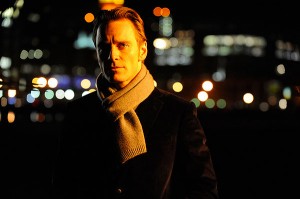

As the last of 2011’s headier fare makes it to town riding the wave of awards-season notoriety, Steve McQueen’s Shame might be the most frustrating of them all. On one hand, part of me would like to score the film higher than the four stars I’ve given it, due solely to its audacity and the unabashed performances of its leads Michael Fassbender and Carey Mulligan. But then there’s another piece of me that still can’t quite warm up to Shame. There’s a side to the film that prevented me from truly caring about its characters—and that kept me from being totally engaged. This, I believe, is the key to unlocking McQueen’s film—you really must be on the same wavelength as the director’s particular arthouse aesthetic.
Shame is a sparse movie, centered around a businessman named Brandon (Fassbender) who suffers from sex addiction. It’s a dependence that causes him to constantly look for sexual release by any means—whether it be with prostitutes or self-gratification—and the addiction is nibbling around the edges of his successful life. But the biggest problem for Brandon is how it walls him in and quarantines him from others.

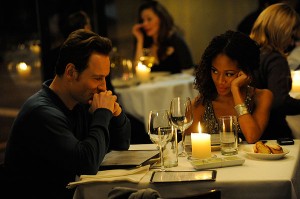
We see it in shades with the people he interacts with—like the co-worker (Nicole Beharie, The Express) he seduces, the way that tryst falls apart, and his ultimate method of coping with this failure. But we’re mostly shown the depth of this struggle when his sister, Sissy (Mulligan), shows up on his doorstep—with her own emotional issues. The scene where Brandon is brought to tears by Sissy’s nightclub rendition of “New York, New York” makes it obvious that he cares about her, but her arrival threatens the shell of privacy he’s built around himself. By the end of the film, the shame the title refers to is less about how the world sees him and more about Brandon’s complicated relationship with Sissy.
This is part of the difficulty I have with the film: Since Brandon wants to keep everyone at arm’s length, the audience is never able to really know him either, and it’s difficult cultivate sympathy towards the man. Fassbender does the best he can though, with a restrained perfomance that nevertheless puts it all out there—in every sense of the phrase. (To echo the ad campaign of Ken Russell’s Savage Messiah, Shame does indeed reveal Mr. Fassbender “full frontal in a scene longer than the normal glimpse.”) The movie earns every bit of its NC-17 rating. Be forewarned, if you have even the slightest aversion to explicit sexual content onscreen, don’t bother with Shame.
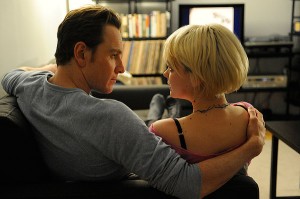
Fassbender’s performance, however, echoes with my problems with McQueen’s direction: Though sneakily brilliant at times, it’s far too stolid and understated. For me, McQueen’s approach is a mixed bag. I admire his visual use of the entire frame, but his long-take approach leaves the film listless. McQueen’s measured, slow pacing can occasionally be mesmerizing, but too often falls prey to being dramatically inert. There’s something intrinsically wrong with a movie that graphically depicts a threesome, and yet my strongest reaction to it is that I wish I had a fast-forward button. The sex in Shame is never erotic or titillating, but that might be the point. Brandon’s addiction isn’t supposed to be fun, it’s supposed to be hellish. McQueen perhaps establishes all too well that it prevents Brandon from connecting with the rest of humanity. The pity then lies in our own inability to really connect with Shame’s characters, making it difficult to truly care. It’s a flaw that ultimately dampens the impact McQueen’s shooting for. Rated NC-17 for some explicit sexual content.

I shared some of your reservations about the film, but I think Fassmember got gypped at the Oscars.
I shared some of your reservations about the film, but I think Fassmember got gypped at the Oscars.
I feel like his glut of roles this year (not necessarily his fault) and a whole lot of performances centered around quietly staring off into the distance(Ryan Gosling in Drive, Michael Shannon in Take Shelter, Tilda Swinton in We Need to Talk About Kevin) didn’t help. But that’s just a theory.
In fairness to Fassmember (I like that), he at least had a few scenes that weren’t in that vacant stare mode, though your point is well taken.
For me, McQueen
In the case of that scene, I was more and more riveted as each of those 17 minutes ticked by. That consecutive shot is actually what opened my eyes to just how impressive an actor Fassbender can be.
I first saw Fassbender in INGLOURIOUS BASTERDS and then saw his other 4 performances from the past year before seeing SHAME. Which of his turns do you like best?
Is this a 17 minute take or a 17 minute take from one fixed camera position?
If I remember correctly, the scene is actually twenty-some-odd-minutes long and it opens with a medium-long unbroken shot that runs 17 minutes. Fassbender sits opposite a prison warden (?) at a table and the camera does remain completely fixed for all 17 minutes. No slow pans or slow zooms or anything. (I remember feeling at times that the camera was surely getting closer, but no; the same surrounding objects disappeared at the edges of the frame throughout the shot’s entirety) For the next 5 minutes or so, we get a series of shot/reverse angle shots of the two actors. Truthfully, the exchange felt more impressive in this series, and I’d have maybe been happier if McQueen made the switch, say, 5 minutes earlier.
Fassbender speaks with a priest about the moral necessity for his decision to fast and, since it will almost certainly result in his death, the priest attempts to persuade him to act otherwise.
You’re right, it’s around 25 minutes total, but the the side take lasts 17 minutes. I too felt like the camera slowly moves in, especially near the end, but I’m not certain. It runs a bit long, but is powerful throughout. For a 90 minute film, it’s wild to think that nearly a third of it comes from a single exchange.
Come Friday Feb. 17, this will have departed Asheville screens.
I first saw Fassbender in INGLOURIOUS BASTERDS and then saw his other 4 performances from the past year before seeing SHAME. Which of his turns do you like best?
Well apparently I first saw him somewhere in the 45 minutes of 300 that I made it through. Next was the pretty brutal Brit horror flick Eden Lake at which point I happily observed that the guy’s performance was certainly stronger than the genre generally requires.
Haven’t seen Shame yet (which should change in a matter of hours) but seen him in most everything else of note, including all 4 performances you’re referring to. I do consider Hunger to be his most memorable and powerful performance. I wasn’t terribly impressed with The Machinist, but essentially anything its avid fans say about that film and Mr. Bale works for me by substituting Hunger and Fassbender.
Fassbender speaks with a priest about the moral necessity for his decision to fast
Yes- a priest, thank you!
The movie earns every bit of its NC-17 rating.
I actually didn’t find the film to be as explicit as I expected. At no point did I feel like McQueen set out to make an NC-17 film. And with the exception perhaps of one scene, I imagine that the MPAA didn’t point to more than a few seconds here and there that they would’ve wanted cut out to assign it an ‘R’ rating. Granted it would’ve been a pretty hard ‘R’…
But then again I sat through 9 Songs earlier this month (a tedious and entirely vapid affair that I don’t recommend) so that could have plenty to do with my more blase response to Shame.
By all other accounts I think we certainly saw the same film. And ‘frustrating’ is a word that came to mind far more often than I’d have liked.
I actually didn’t find the film to be as explicit as I expected.
From the way people have been talking about it, I was expecting wall to wall Fassbender cock for 90 minutes.
It only has a little more than a cameo. It’s got about the same amount of screentime as Malcolm McDowell in THE ARTIST.
That said, it makes a lot of impact in a short space of time.
That said, it makes a lot of impact in a short space of time.
So to speak.
The sex in Shame is never erotic or titillating, but that might be the point. Brandon