After former Buncombe County Sheriff Bobby Medford took the stand today in his own defense against federal corruption charges, he faced lengthy questioning from his own attorneys, followed by a barrage from the prosecution. He denied ever taking bribes from illegal video-poker operators.
During questioning from his attorney, Stephen Lindsay, Medford flatly denied ever being paid bribes by any of the video-poker operators who testified last week that they’d given thousands to Medford in return for protection of their operations.
Hunched over the microphone in a dark brown suit, hand gripping the witness stand, Medford said he’d only met Jerry Pennington, the former operator for Henderson Amusement in this area, twice. Both times, he said, he rebuked Pennington for being too close to former reserve Capt. Guy Penland (who’s also on trial), who, he felt was being used by Pennington.
“I felt that it didn’t look right [Penland riding with Pennington] and that he [Pennington] was taking advantage of Guy,” Medford told the court.
He recalled that he was especially angry after learning that Penland had been signing off on video-poker registrations. As an unpaid volunteer, Medford said Penland wasn’t authorized to carry out such a task.
Medford said that he had made a rule prohibiting operators from taking each other’s business, and had told Jim Lindsey, of Mountain Amusements, that he couldn’t go through with such a step in convenience stores owned by businessman Imran Alam.
“I said that he wasn’t to be sent back to my office or brought to me — I wasn’t going to change my mind and I didn’t have time for it,” Medford said. He added that he’d bust video-poker machines giving illegal cash payouts when he got complaints about them, but due to a lack of funding, didn’t regard the matter as a high priority.
However, Lindsey and Alam, who both testified last week, said they bribed Medford on more than one occasion. Alam in particular said that after giving $3,000 to Medford and the same amount to former Lt. Johnny Harrison (who’s taken a government plea deal), Medford relaxed his usual rule and let new machines come in.
Medford’s attorney Lindsay also showed the jury pictures of Medford’s $350-a-month apartment in Weaverville and revealed that he was supporting his grandchild as well.
The former sheriff also asserted that while nonelection-year fundraising golf tournaments were “put on for me,” and that the profits (in cash) went to him, the sums ranged from $2,500 to $3,000 and went to charitable causes — causes, he said, he’d funded out of his own pocket before the golf tournaments came along.
“If someone came in the office and needed some help,” Medford said, he used the money to assist residents with things such as heating oil or clothes for their children.
But later, under cross examination from the prosecution, Medford said “the money wasn’t mine, it went to Sheriff’s Office,” and asserted it was all spent on charity. He never stayed long at the golf tournaments, which included teams sponsored by video-poker operator,s and said he wasn’t aware of their involvement.
“I just said ‘Hello’ and thanked everybody,” he noted. “I had to get back to work.”
The prosecutors also showed records from tournaments in 2005 and 2006, which had raked in between $9,000 and $11,700 in profits. Last week, Frank Orr, who managed the tournaments for Medford, said that on a good year, a tournament would make around $11,500.
“What is the reason for the disparity here, that you say you only got $2,500?” Assistant U.S. Attorney Corey Ellis asked Medford.
“I can’t recall ever getting more,” Medford replied.
The prosecution also pointedly questioned Medford about specific cash deposits going into the accounts of him and his girlfriend, Judi Bell. Medford said his sources of money were legitimate, coming from injury settlements with the county, from cashing in his 401(k), from lines of credit and a credit card. This, he said, accounted for much of the money he spent at Harrah’s Cherokee Casino, including his more than $30,000 in gambling losses in 2005 and more than $50,000 in 2006.
“I had credit cards, I had a signature loan — I could get money from anybody,” he said, clarifying that he meant friends and family members.
During repeated questioning about specific transactions, however, he shook his head and said he couldn’t recall them.
“Would you say you have a gambling addiction, Mr. Medford?” Corey Ellis asked towards the end of today’s questioning.
Lindsay objected, but Judge Tim Ellis (no relation to the prosecutor) overruled it.
“No,” Medford answered. “For my first eight years [in office] I hardly did it. But I got old and sick; I wanted to do something else.”
The prosecution resumes its questioning of Medford tomorrow in the federal courthouse.
— David Forbes, staff writer
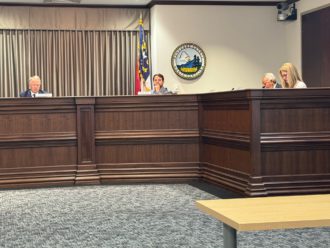
Facing a packed agenda, Council will receive an update on its finances at its May 13 meeting as budget writing season kicks into gear.
Also on Council’s plate is discussion of the proposed Swannanoa incorporation and a resolution to change how the city handles event co-sponsorships.
Council will conduct two public hearings, the first to consider an amendment to the Unified Development Ordinance to establish standards for digital billboards. The second will review an amendment to the conditional-zoning ordinance for property located at 1741 Hendersonville Road regarding signage for the Weirbridge Village Project. However, at staff’s behest, this item likely will be postponed until May 27.
To access the entire Council agenda and background documents, click here.
The meeting will take place at 5 p.m. on Tuesday, May 13 in Council chambers on the second floor of City Hall. The meeting will also be carried live on city-government channel 11 on Charter Cable.
— Hal L. Millard, staff writer

Former Buncombe County Sheriff Bobby Medford took the stand Monday morning to answer questions in his on-going federal corruption trial.
Stephen Lindsay, Medford’s defense attorney, said on Friday that he planned to call Medford’s chief deputy, George Stewart, and Medford’s long-time girlfriend, Judi Bell, to testify. But after a conference with Judge Tim Ellis and the other attorneys in the case, Lindsay called Medford to the stand.
Medford told the court about his law-enforcement career and described how his office handled the registration of video-poker machines after state lawmakers passed a law in 2000 allowing the machines in North Carolina. He said his office, strapped of cash, had not viewed video-poker registration as a top priority.
“I’ve never seen one [a registration sticker for a video-poker machine], except on a machine,” Medford testified. He later added that at a 2000 meeting to explain new video-poker laws to operators, he only gave a brief introduction before letting deputies handle the meeting itself.
“I was busy. There was an office full of people waiting to see me about other things,” Medford said.
Medford’s testimony resumes at 11:20 in the federal courthouse.
— Jason Sandford, multimedia editor and David Forbes, staff writer
At the outset of Progress Energy’s Community Energy Advisory Council meeting yesterday, a handful of checks were presented to various community members to aid their organizations. These grant recipients had sent in proposals for energy-efficiency projects, and Progress’ CEAC awarded a total of $25,000 to fund them. Below is a breakdown of the projects.
• The Asheville-Buncombe Technical Community College Foundation received $2,500 for the installation of a photovoltaic, solar-generation system in the Engineering and Applied Technology Division at A-B Tech. The goal is to provide educational and training support for green technology.
• The city of Asheville Housing Authority received $4,550 for the installation of solar hot water for at least 400 units of public housing. The grant funds will pay for a weeklong solar-energy training program, which 10 residents from public housing will complete as part of a contract with Appalachian Energy.
• The Clean Air Community Trust received $7,000 for its Youth Leadership in Energy Efficiency Project, a pilot program for a youth climate corps. This will allow students from Asheville-area high schools to perform energy-efficiency retrofits, and those students will lead volunteers in performing retrofits for low-income residents of the area.
• Haywood Community College received $6,000 for its Demonstration House — a permanent home built on campus with energy efficiency and conservation elements. The house will be used to train students in building, construction, electrical and plumbing practices for energy efficiency. The money will fund solar-hot-water and solar-heating-system installations.
• Mountain Housing Opportunities was awarded $4,100 to put toward the purchase of 853 compact-fluorescent light bulbs for installation in Crowell Park, its newest affordable-housing and apartment complex.
• The WNC Nature Center received $850 to purchase 100 CFLs as spotlights for their indoor exhibits.
— Rebecca Bowe, contributing editor

The Jamaican restaurant One Love II opens its doors on Sunday. The restaurant is located in downtown Asheville, in the Market Street building that housed the soul-food eatery The Ritz since 1942. That restaurant held its last lunch buffet on Valentine’s Day.
Now the new restaurant appears ready to open on Mother’s Day, boasting a menu of traditional Jamaican dishes like curried goat and jerk chicken. This is second incarnation of the One Love restaurant. This first is located in Hendersonville.
— Brian Postelle, staff writer
Pictured: Lloyd Bulgin outside One Love II on Market Street.

So the long wait for the North Carolina primaries finally ended this week. As expected, Scrutiny Hooligans dominated the live blogging scene. In fact, from this pic at Liminal Screeds, you could say Scrutiny Hooligans carried Obama in Buncombe County.
So now its back to the political waiting game, but hey — life goes on. Even the hooligans are moving to a new location, and What to Expect, typically a mainstay in the political discourse, chose chocolate instead.
On the day after the election, Mountain Mama had nothing to say, as is normal on Wordless Wednesdays.
She Who Eats presented a poem about another horse race.
Virtual Inanity reminds us that there is work to be done locally with the Downtown Master Plan survey.
Pacho’s Via wrestled with the personal ethics of an economic-stimulus check (the check won), while Nice Marmot found time to make a list of things un-gettable.
Over at Restless Mama, there were so many things going on that someone just plain passed out.
Skippy Haha wants you to remember your mother this weekend, but Distort the Info wants mom to remember some things herself.
And if, after this week has finally gone by, you still need to vote for something, George the Bastard needs your support.
— Brian Postelle, staff writer

Defense attorneys for former Buncombe County Sheriff Bobby Medford called four of his ex-employees to the stand Thursday morning to testify in his federal corruption trial.
First up was current Sheriff Van Duncan, who once worked as a deputy under Medford and defeated Medford in the 2006 elections. Duncan testified that in October 2006, about a month before the election, he talked with Tracy Keith Bridges, a deputy who ran the internal-affairs division of the Sheriff’s Department. Bridges said in court Wednesday that he would take cash and use it to purchase money orders in an effort to dodge campaign-finance laws.
Duncan said Bridges approached him at a Starbucks coffee shop. Duncan said Bridges identified himself as the treasurer of Medford’s re-election campaign. Duncan said he told Bridges that “if he felt he was in trouble, he needed to go speak with the FBI.” Duncan said he told an FBI task-force member — a former colleague from the Sheriff’s Department — about his conversation with Bridges.
Julie Kepple, the staff attorney for the Sheriff’s Department from 2002 through 2006, was the next defense witness. Kepple currently works as an assistant district attorney under Buncombe County District Attorney Ron Moore.
Kepple said that in December 2003, she responded to a local newspaper’s public-records request to see the Sheriff’s Department’s video-poker-machine registration records. Kepple said she talked with former Lt. Johnny Harrison and former reserve Capt. Guy Penland, who oversaw the machine registrations, and discovered that “the records weren’t kept very well.”
Kepple said Penland and Harrison contacted the video-poker-machine operators in the county and asked for updated paperwork on the number of machines they had and where they were located, and that she shared those records with the newspaper. Kepple said she also drafted a letter for Medford to sign that asked video-poker-machine owners to supply annual reports on the number of machines they owned and where they were located.
The next defense witness, Jerry Wayne Miller, told the court that he went to work for Medford in October 2004 after working for 24 years as both a U.S. attorney and assistant U.S. attorney in Asheville’s federal court. Miller said he was assigned the rank of major and reported directly to Medford.
Miller said that in the late fall or early summer of 2005, a “close friend” told him of allegations against Medford. The allegations included the illegal operation of video-poker machines in Buncombe County and that law enforcement was receiving money from illegal game owners and operators. “He said he didn’t want me near when the bomb went off, “ Miller said. “He was basically giving me a heads up.”
Miller said he told Medford about the conversation and that Medford “blew up.” Miller said he researched how Medford could force the removal of the machines from Buncombe County. There wasn’t follow-up action on that research, Miller said.
The last defense witness of the morning was Medford’s former secretary, Rhonda House. She said she never saw anyone hand Medford envelopes of cash and that she never knew of meetings between Medford and video-poker-machine owners and operators that defense witnesses have testified about.
The court recessed for lunch. When it resumes, Medford’s defense team said it expects to call Medford’s former chief deputy, George Stewart, to the stand, as well as Medford’s long-time girlfriend, Judi Bell.
— Jason Sandford, multimedia editor
Government prosecutors finished presenting their federal corruption case against former Buncombe County Sheriff Bobby Medford Thursday morning.
The government’s last witness was Jim Lindsey, another former video-poker-machine operator, who testified that he loaned Medford money for a personal vacation and gave money to Medford’s golf tournaments in both election and non-election years.
After a morning break, the defense will begin presenting its case. Defense attorney Steve Lindsay said his first witness would be Buncombe County Sheriff Van Duncan, a deputy under Medford who beat him in the 2006 elections. Also listening in court this morning was Rutherford County Sheriff Jack Conner. Conner has cooperated with federal agents in their sweeping investigation into illegal gambling across Western North Carolina.
— Jason Sandford, multimedia editor

The Pack Square Conservancy got some good news Wednesday: A long-awaited $7.5 million contract on construction of Pack Square Park in downtown Asheville will likely be signed this week.
Once the deal with Valley Crest Landscape Design Inc. is inked, construction should be in full gear by early to mid June, according to Mark Durbin, the owner’s representative for the Pack Square Conservancy. Durbin said the contract was in the process of being updated and then forwarded to Asheville City Manager Gary Jackson for his signature.
The start of construction will be a milestone in a project that has been marked by setbacks and rising costs, and there’s been controversy over design elements in the park. The Pack Square Conservancy was formed in 2000 by an agreement with it, Asheville City Council and the Buncombe County Board of Commissioners. The conservancy was given the authority for overseeing the planning, design, fundraising and construction of the 6.5-acre park.
The board of local leaders broke ground at the site in 2005. Last year, the conservancy said the project was expected to cost $17.5 million. At the conservancy’s meeting Wednesday, the board said the cost was expected to be $22 million.
At the meeting Wednesday, conservancy board members expressed concern about the construction’s impact on local businesses in the area. The board is planning a meeting later this month to explain details of the construction to business owners.
— Jason Sandford, multimedia editor

In the federal corruption trial of former Buncombe County Sheriff Bobby Medford, a former captain testified that after hearing concerns from his campaign chair about cash being improperly turned into money orders, Medford responded, “F*ck him. We’ll keep doing what we’re doing.”
Tracy Keith Bridges, who used to run the Sheriff’s Office’s internal-affairs division and has pled guilty to money laundering, said that he’d take cash given to Medford’s 2006 re-election campaign and turn it into money orders so it could skirt campaign-finance laws. Former Lt. Ronnie “Butch” Davis (who’s also taken a plea deal) would then provide Bridges with a list of campaign donors whose names, he testified, would be falsely placed on the money orders.
Bridges testified that during a meeting with Medford, Bridges and Sharon Stewart (Medford’s office manager and former personal secretary), that David Brown, Medford’s campaign chair, had expressed concerns about cash being changed into money orders. Bridges testified that Medford rebuked Bridges during the meeting and told him to stop the practice.
“I got the feeling he was putting on a show,” Bridges told the courtroom. After Brown left the office, Bridges said, Medford bluntly told him matters would continue as before.
Bridges also testified that occasionally Medford would ask for cash out of the amounts — some of it coming from illegal video-poker operators — he was converting into money orders, usually in increments of $1,000, $700 or $500. Medford warned Bridges not to tell Davis, according to Bridges’ testimony.
Bridges added that he knew what he was doing was illegal, but was afraid.
“I was scared for my job,” Bridges told the court. “I wanted to keep being employed there.”
Medford also once had him deposit $500 cash in the account of Medford’s girlfriend, Judi Bell, Bridges said. Prosecutors presented bank records showing the deposit the same day, along with a check for the same amount to Harrah’s Cherokee Casino, as part of their case that Medford used much of the money from bribes to fund his legal-gambling habit (he reportedly had over $50,000 in gambling losses in 2006).
Before Bridges, Jenny Watts, who works at Premier Federal Credit Union, testified that the couple had collective cash deposits of $113,694 above and beyond their salaries from 2002 to 2006. Defense attorney Stephen Lindsay noted that Medford had access to other forms of money, such as loans, a credit card or money from other banks. Watts said that Medford would occasionally take out loans ranging from a few hundred dollars to $4,000.
Earlier that morning, video-poker operator Charles McBennett, who has confessed to operating 30 video-poker machines (all making illegal cash payouts) in the county, said he bribed Medford on two occasions.
Once, just before Medford underwent back surgery, McBennett stated that former Lt. Johnny Harrison (who has taken a plea deal and testified last week) brought McBennett to Medford’s office, where McBennett gave Medford a small cross that said “God watches over you,” along with $5,000 in cash.
The bribe, McBennett said, was to get information about his competitors so that he could get any dissatisfied store owners to switch to his company. In an effort to prevent turf wars, Medford usually didn’t allow such changes.
McBennett said that former reserve Capt. Guy Penland (on trial along with Medford) even gave him the name of one operator particularly disliked by the sheriff and encouraged him to move in on the other man’s territory.
Another time, McBennett testified, he and Harrison made a trip to Medford’s Weaverville apartment shortly after the sheriff’s surgery. That time too, he bought along $5,000, but Harrison ended up with $2,000 of it.
“He [Harrison] said, ‘Don’t give him all that,’” McBennett recalled.
During the afternoon, the prosecution successfully entered a video recording as evidence, over the defense’s objections. In the video, the prosecution claimed, current Rutherford County Sheriff Jack Conner and John Parker meet with Jamie Henderson of Henderson Amusements, the largest single illegal video-poker operator in Buncombe, and Jeff Childers, a salesman for Henderson in the Rutherford area.
Parker, a former Rutherford County deputy, was at that time assisting the FBI in investigating illegal gambling, and the meeting was part of a sting operation (Conners also participated).
The video, which will be shown to jurors tomorrow, depicts Henderson and Childers giving money to Conner and reassuring him that other sheriffs in the region are involved. While Medford had been defeated in his bid for re-election by the time the video was recorded, in December 2006, he is mentioned as one of the recipients of Henderson bribes.
The defense contested that the video involves a different criminal conspiracy than the one allegedly involving Medford — and was thus inadmissable. The prosecution shot back that Henderson’s conspiracy reached across the whole region, and that Medford’s piece of it, while the focus of this trial, was not separate from the larger operation.
Judge Tim Ellis found the prosecution’s argument convincing.
“The law clearly shows that a participant in a conspiracy doesn’t have to be aware of the full extent of it ,” Ellis said.
U.S. Attorney Gretchen Shappert (whose district includes the Charlotte area), the supervisor of Assistant U.S. Attorney Richard Edwards, the case’s lead prosecutor, briefly stopped by to watch the proceedings. Medford pored over the evidence presented, while occasionally leaning over to whisper to defense attorney Victoria Jayne
The trial resumes tomorrow at 9 a.m.
— David Forbes, staff writer

Asheville city officials on Wednesday announced the hiring of a new planning director. Judy Daniel, who has been working as the planning director for an agency that oversaw land-use planning and parks and recreation services in Montgomery and Prince George’s counties in Maryland, will start her new job June 30, according to a city news release.
The announcement comes nearly a year after Scott Shuford, Asheville’s former planning director, resigned his job. In March 2007, four Asheville City Council members told Xpress that five of the seven Council members had told City Manager Gary Jackson they felt a lack of confidence in Shuford’s management and enforcement decisions, expressing disappointment in his relationships with both members of the community at large and the development community.
Shuford had been planning director for almost eight years. He took the job shortly after the Unified Development Ordinance was approved, and he oversaw numerous refinements and amendments to that massive planning document.
Here’s the city’s press release:
The city of Asheville today announced that Judy Daniel has been selected as the city’s new Planning director. Daniel will assume her new role on June 30.
Daniel comes to Asheville from Bethesda, Md., and brings more than 20 years of experience in planning to her position. Daniel most recently served as the North Bethesda planning director for the Maryland-National Capital Park and Planning Commission (M-NCPPC), an agency responsible for land use planning and parks and recreation services in Montgomery and Prince George’s Counties. The organization serves more than 900,000 residents just north of Washington, D.C.
Prior to her role as North Bethesda Planning Director, Daniel worked as the Northern Montgomery County planning director and a zoning analyst with M-NCPPC. She also worked as the planning director for Williamson County, Tenn., and a planning consultant for the U.S. Commonwealth of the Northern Mariana Islands.
As a planning director with M-NCPPC, Daniel has been responsible for supervising updates to three area master plans that incorporate mixed-use, transit-oriented zoning. She recently completed work on hybrid form-based zoning for use in urban areas, and she has been responsible for planning efforts that allow for market flexibility as well as improved standards for design and public spaces while encouraging the growth and retention of local businesses.
“After an extensive national search, I believe we have selected someone who not only has the background and skills to lead our planning efforts but someone who also has the listening, learning and people skills to encourage wide community participation,” said City Manager Gary Jackson. “I appreciate all of the community input I received about what Asheville wants in a new planning director, and I think citizens will embrace Judy’s approach and see her leadership style as one that is open to all segments of the community.”
Daniel holds master’s degrees in City and Regional Planning and Urban History from the University of Memphis. She received a Bachelor of Arts in English from the University of Mississippi. She has served as President of the American Planning Association’s National Capital Area Chapter as well as the Chair of the American Planning Association’s National Conference in 2004.
“I’m excited about the opportunity to lead the planning efforts in a dynamic community like Asheville,” said Daniel. “I have long appreciated Asheville’s beauty, its residents and its unique character, and I’m looking forward to working with the citizens in the community.”
— Jason Sandford